Muxerista Circles as Spirit Restoration: Healing Pedagogies in Ethnic and Gender Studies by Diana Solis

Muxerista Circles as Spirit Restoration: Healing Pedagogies in Ethnic and Gender Studies by Diana Solis

Student News

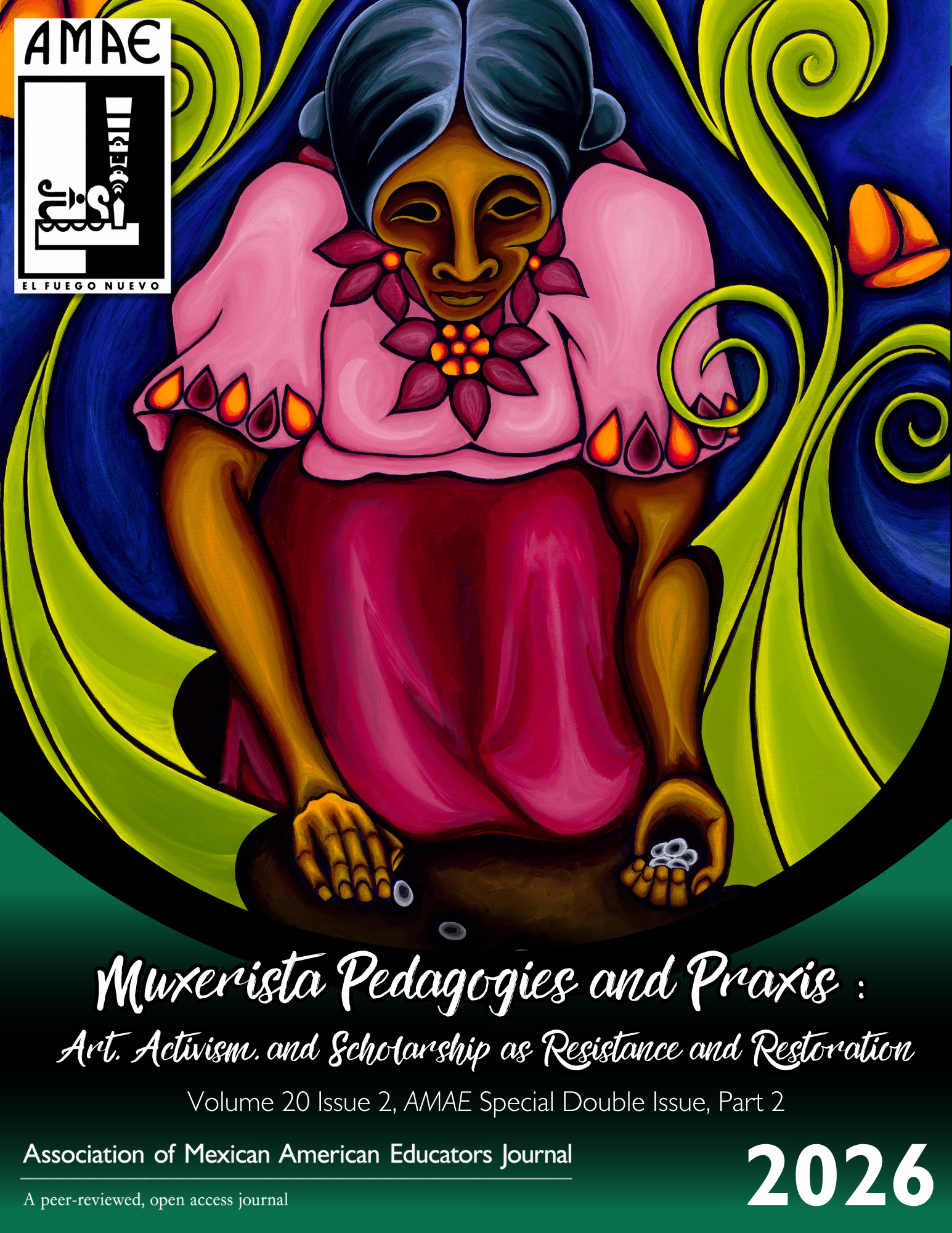
Ethnic Studies Graduate Student Diana Solis recently published an article based on her master’s thesis in Issue 2 of the Association of Mexican American Educators (AMAE) Journal Special Double Issue, “Muxerista Pedagogies and Praxis: Art, Activism, and Scholarship as Resistance and Restoration.” The abstract for the article, titled “Muxerista Circles as Spirit Restoration: Healing Pedagogies in Ethnic and Gender Studies,” follows:

This article examines how Muxerista Circles function as healing-centered pedagogical interventions within ethnic and gender studies classrooms. I draw on Muxerista Consciousness and Chicana feminist epistemology to explore how students and educators navigate academic spirit murder in higher education. Using a community-based participatory research approach, I facilitated a Muxerista Circle in a graduate ethnic studies seminar and conducted follow-up interviews with participants to examine their experiences. Participants described the Circle as a space that cultivated emotional release, collective care, and relational accountability within an academic environment that often reproduces racialized and gendered harm. Two reflections were generated from the Muxerista Circles that center Muxerista Healing Praxis and Community Building. These reflections demonstrate how intentionally facilitated healing spaces can support spirit restoration while strengthening feminist pedagogy in the classroom. I conclude by offering a Muxerista Circle Toolkit that translates these reflections into a practical framework educators can adapt to cultivate healing, reflection, and community within ethnic and gender studies courses.

Read the full article on the journal’s website: https://doi.org/10.24974/amae.20.2.548

Read the special issue announcement: https://amaejournal.utsa.edu/index.php/AMAE/announcement
Archives of Dissent: First Friday the Unauthorized News and the Legacy of Haunani-Kay Trask

Archives of Dissent: First Friday the Unauthorized News and the Legacy of Haunani-Kay Trask

Faculty News

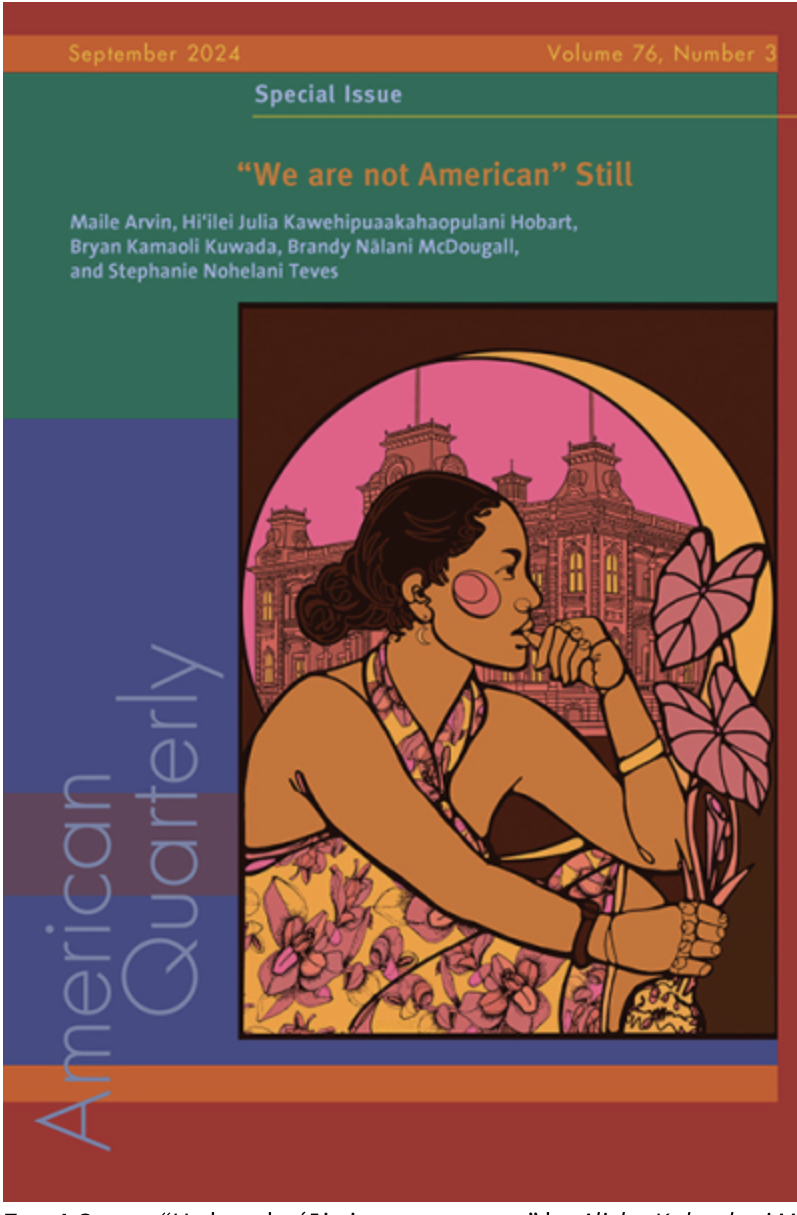
Associate Professor Kēhaulani Vaughn recently published an article, “Archives of Dissent: First Friday the Unauthorized News and the Legacy of Haunani-Kay Trask” in a special issue of American Quarterly. In the article Vaughn traces Trask’s discussions regarding Hawaiian sovereignty and the archive of refusal of Americanness that Trask presented via public access television.

Here is the article abstract:

On March 11, 2022, ‘Ōlelo TV aired its last episode of First Friday: The Unauthorized News, which honored the life and accomplishments of Dr. Haunani-Kay Trask. Running intermittently for over thirty-five years, First Friday covered news and perspectives not discussed by local and mainstream media sources in Hawai’i. The show was initially formed in equal collaboration between John Witeck, Jo Scheder, Haunani-Kay Trask, and David Stannard and cohosted by Stannard, Trask, and later her sister Mililani Trask. First Friday included discussions of Hawaiian sovereignty that unapologetically centered Hawaiian viewpoints. The show aimed to educate and empower its viewers to get involved in local, state, and international politics, and was a significant example of independent news media. Although First Friday covered a range of topics both local and global, this essay begins to trace the legacy of Haunani-Kay Trask through her conversations on sovereignty on First Friday and her refusal of Americanness.

Dr. Anthony Macías’s New Book Receives Honorable Mention, 2024 International Latino Book Award

Dr. Anthony Macías’s New Book Receives Honorable Mention, 2024 International Latino Book Award

Faculty News

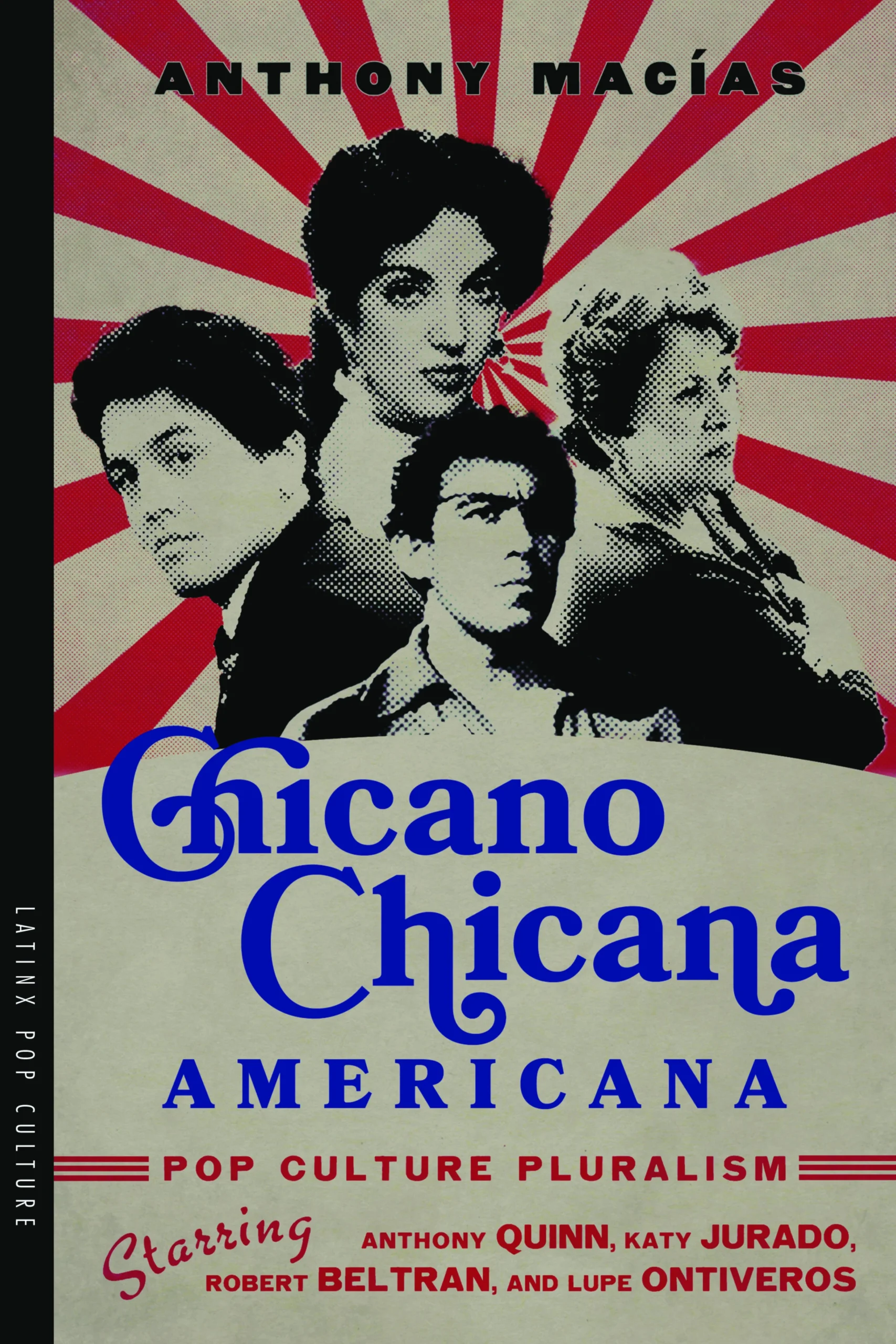
Dr. Anthony Macías’s new book, Chicano-Chicana Americana: Pop Culture Pluralism Starring Anthony Quinn, Katy Jurado, Robert Beltran, and Lupe Ontiveros (Tucson: University of Arizona Press, 2023), has earned Honorable Mention, 2024 International Latino Book Award, Best Academic Themed Book, College Level.

Please join us in congratulating Dr. Macias!


Chicano-Chicana Americana is a cultural history of Mexican Americans in film, television, and theater. Through biographical sketches of performers such as Anthony Quinn, Katy Jurado, Robert Beltran, and Lupe Ontiveros, this work asserts Mexican Americans’ proper place in the national narratives of our collective imaginary. Conveying a multicentered, polycultural America, this book shows us intriguing performers in bit parts who steal the scene and redefine what it means to be American.

Each biographical chapter analyzes an underappreciated actor, revealing their artistic contributions to U.S. common culture. Their long-shot careers tell a tale of players taking action with agency and fighting for screen time and equal opportunity despite disadvantages and differential treatment in Hollywood. These dynamic and complex individuals altered cinematic representations—and audience expectations—by surpassing stereotypes.

The book explores American national character by showing how ethnic Mexicans attained social and cultural status through fair, open competition without a radical realignment of political or economic structures. Their creative achievements demanded dignity and earned respect. Anthony Macías argues that these performances demonstrated a pop culture pluralism that subtly changed mainstream America, transforming it from the mythological past of the Wild West to the speculative future of science fiction.

View book on publisher website

Boundless Conversations for Boundless Liberation, by Sneha George, Ethnic Studies PhD Candidate

Boundless Conversations for Boundless Liberation, by Sneha George, Ethnic Studies PhD Candidate

Student News

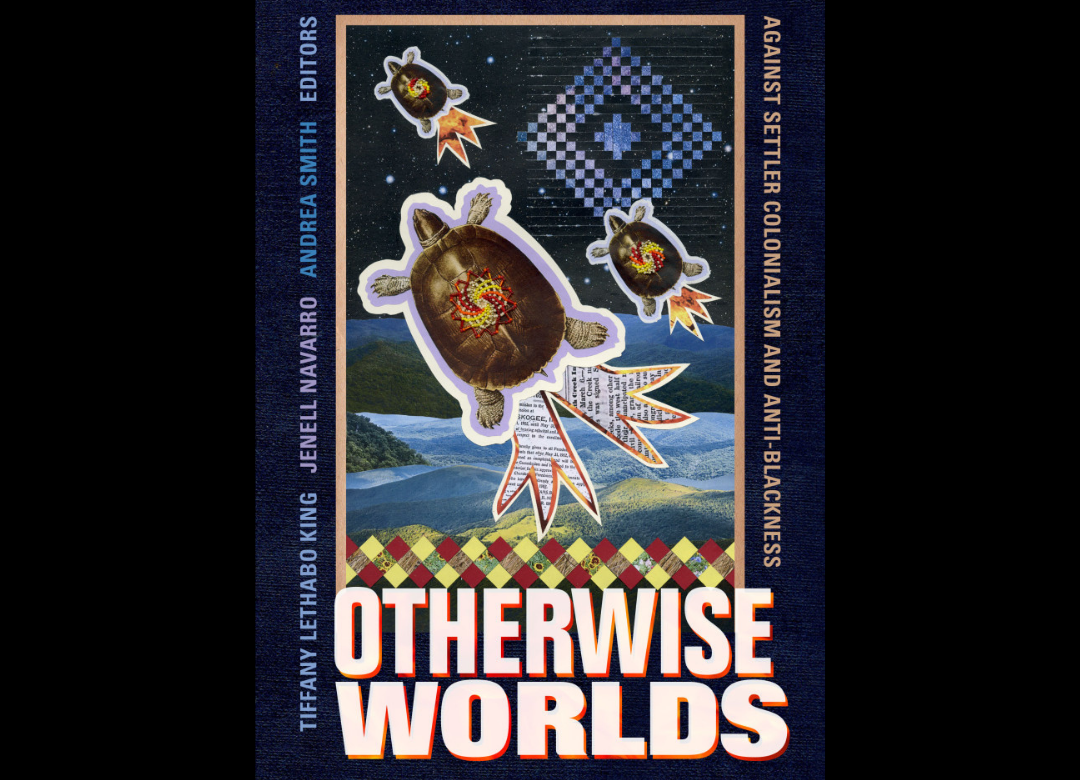
Ethnic Studies PhD Candidate, Sneha George, reviewed the collection, Otherwise Worlds: Against Settler Colonialism and Anti-Blackness, for Ancillary Review of Books. Excerpt below:

Despite insurmountable conflict between Native and Black studies being the point of tension of this book, each section of this book is labeled as “Boundless” something. For example, the first section is labeled “Boundless Bodies.” The term boundless forces the reader to pause because you wonder: would insurmountability be an issue if we were truly boundless, if we could become boundless? For example, in the recent tensions between Asian Americans and Black people, would there be tension if Asian Americans were not bound to anti-Black and carceral practices such as linking public safety and police? More generally, would any of our liberatory strategies run into conflict if we were not bound to capitalism, carcerality, and the ideologies of white supremacy? How do we unbind ourselves? How do we explode the bindings that occludes collective liberation?

In the first portion of the book, “Boundless Bodies,” Frank B. Wilderson III, author of Afropessimism and Red, White & Black, and Tiffany Lethabo King, who recently wrote The Black Shoals: Offshore Formations of Black and Native Studies, engage in conversation to address the supposedly insurmountable tension between Native organizing and Black organizing. King lets readers know that this was a two part conversation. The first part was uncomfortable for King because she realized she was being “forced to contend with Wilderson’s change of mind and heart about the potential for the Native’s ‘grammar of suffering’ of genocide and the Black’s ‘grammar of suffering’ of fungibility to speak to one another.” Put differently, King was forced to realize that the practice of Native organizing, and the way it articulates itself, requires the suffering of Black people. It does so by using “sovereignty” and ownership of land as the definition of liberation. In Otherwise Worlds, Wilderson, along with Jared Sexton and Andrea Smith, problematize this stance as being fundamentally anti-Black. Wilderson, Sexton, and Smith state that sovereignty and ownership of land always presumes a hierarchy of being and a white-patriarchal understanding of property, ownership, and capital, all of which contribute to the ideologies that render Black people as non-Human.

King cut this conversation short to avoid this discomfort and tension, but she later reached out to Wilderson for a second discussion. The second conversation situates itself in this tension and continues the discussion. King and Wilderson have another enlightening conversation that offers no solutions, no prescriptive analysis on organizing for liberation, and causes the reader to have more questions than resolution. A sort of paradoxical boundlessness came in the moment King decided to continue the conversation past the tensions that came up at first. The paradoxical boundlessness is that, although the conversation did not find a resolution to  the ways in which we are bound to insurmountable tensions, the conversation keeps moving, changing, adding on to itself despite the bindings—within the bindings. Perhaps more than the theories, perhaps even in spite of them, it is the practice of conversing, the creation of a relationship and connection with someone through these conversations that allows for the paradox of boundlessness to come to fruition.

Read the full review here.