
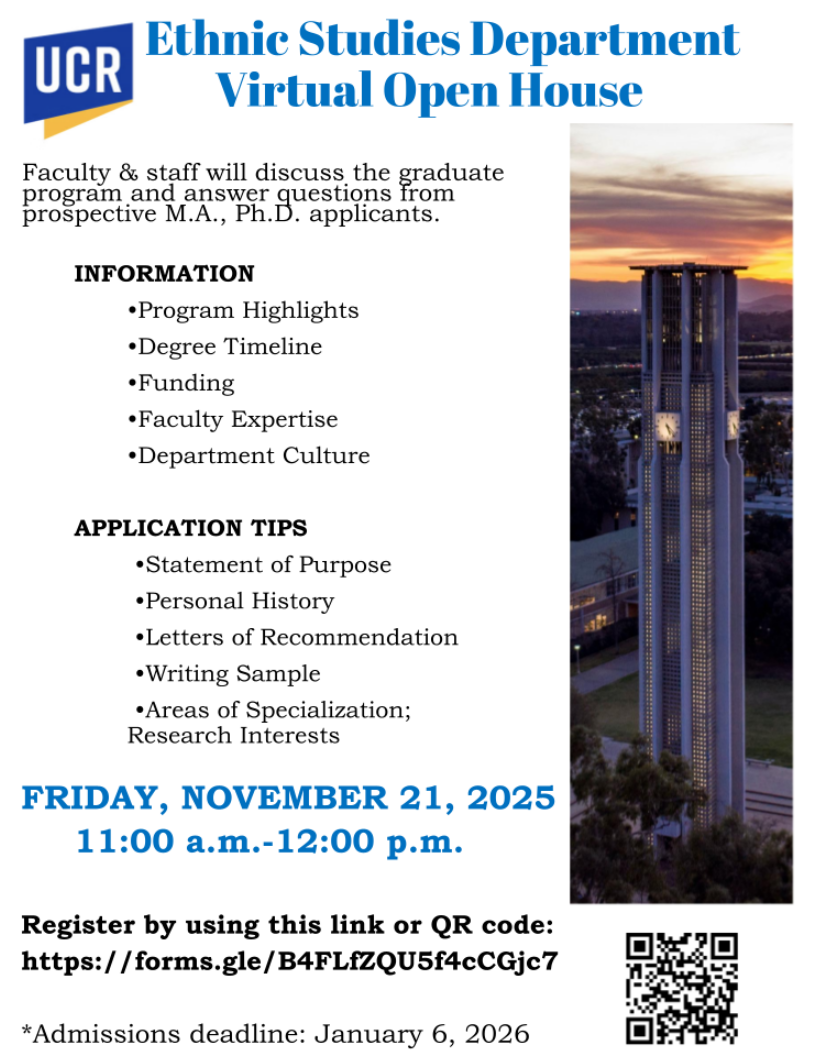
We welcome prospective graduate students to join us for our virtual open house
Friday, November 21, 2025
11:00 am – 12:00 pm
Register here: https://forms.gle/B4FLfZQU5f4cCGjc7

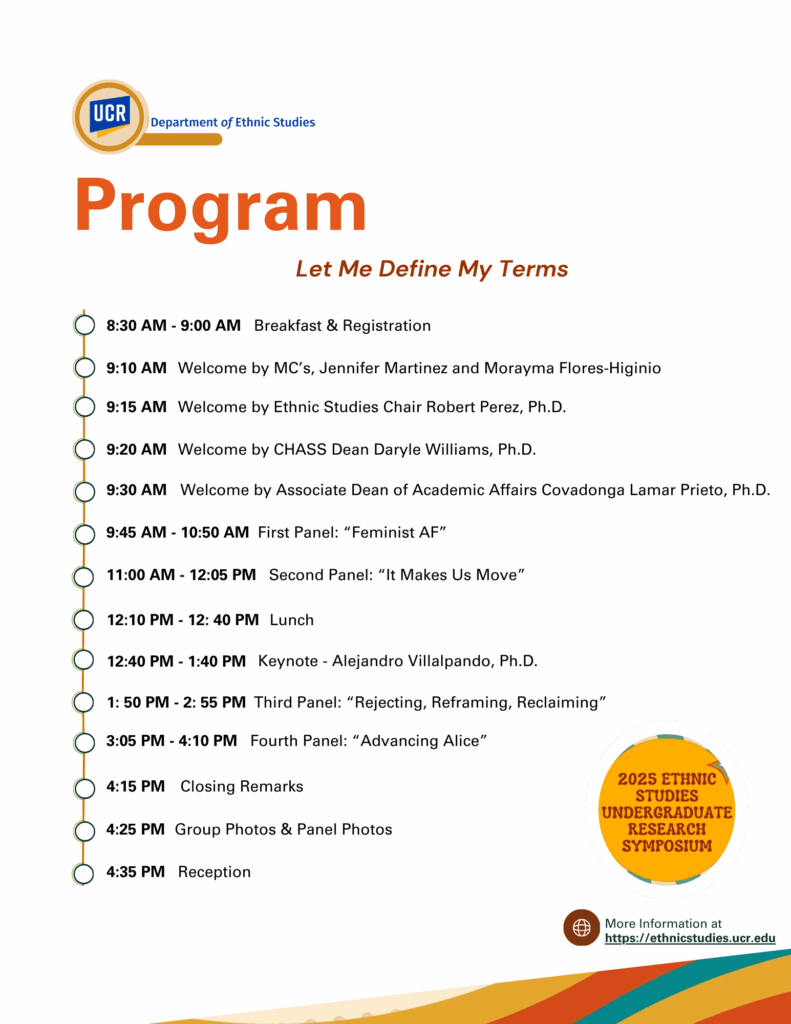
This symposium will showcase how undergraduate students are conducting meaningful research on race, gender, and sexuality. It empowers students to effectively communicate the significance of their work within academic circles and, crucially, within the broader context of American society. Twelve undergraduate participants will present original research related to ethnic studies on the topic of their choosing.
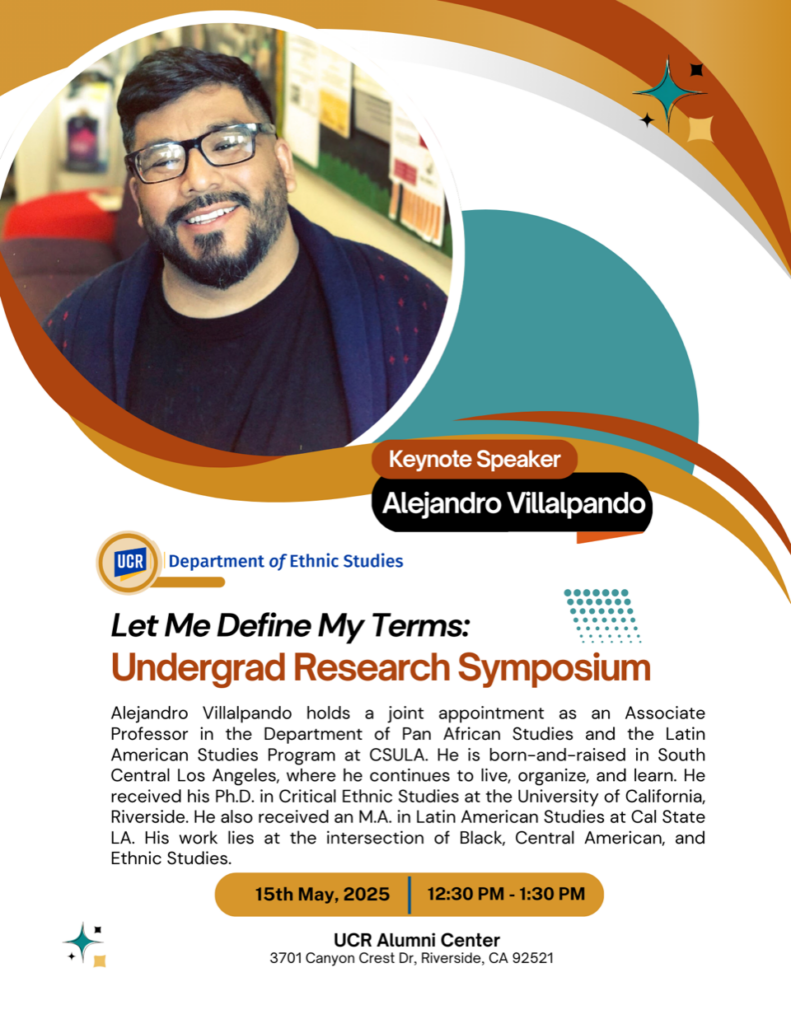
This one-day symposium will feature Dr. Alejandro Villalpando as keynote speaker, and four moderated panels of undergraduate research papers selected from a highly competitive pool of applicants representing UCR and other colleges and universities from across the country.
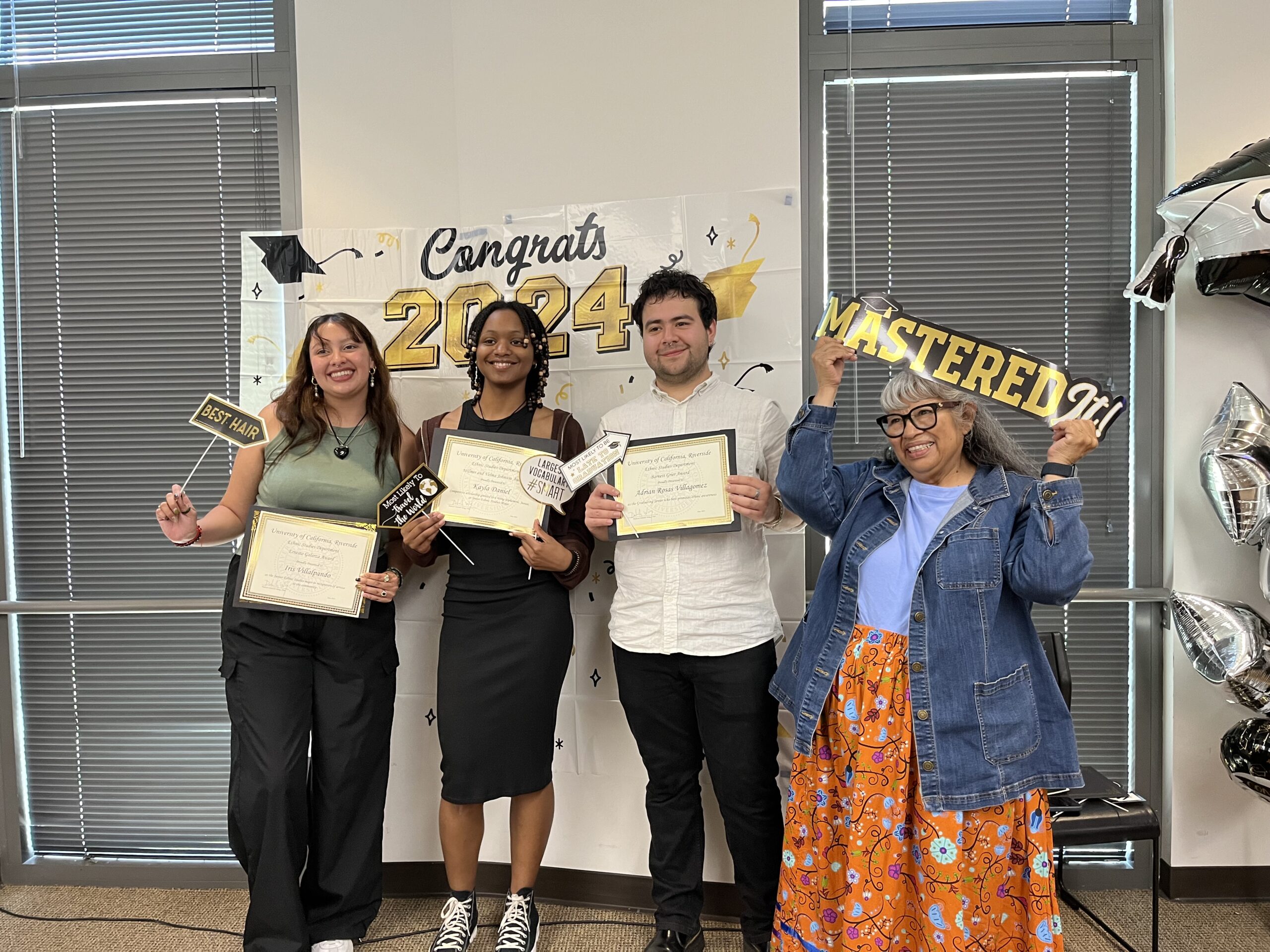
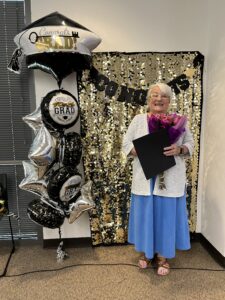
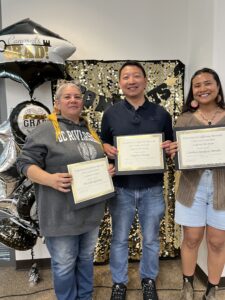
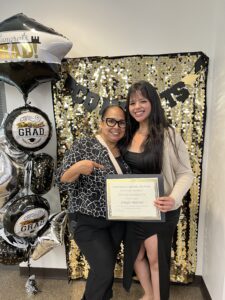
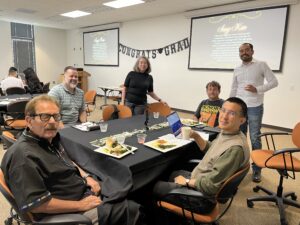
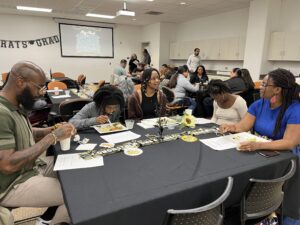
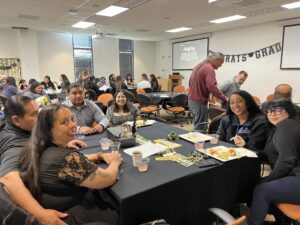
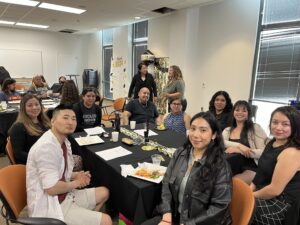
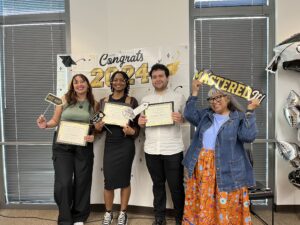
On June 3, 2024, the Ethnic Studies Department held its annual awards and graduation ceremony. In addition to honoring our graduating undergraduate and graduate students, we had the pleasure of celebrating the 2023–24 award recipients.
Wilmer and Velma Johnson Ethnic Studies Undergraduate Award (Competitive scholarship granted to a rising Sophomore, Junior, or Senior Ethnic Studies Major)
Dosan Ahn Chang-Ho Award (Junior Ethnic Studies major with the highest overall GPA)
Maurice Jackson Award (Graduating Ethnic Studies major with the highest overall GPA)
Ernesto Galarza Award (Junior Ethnic Studies major in recognition of service to the community)
Katherine Saubel Award (Graduating senior who best promotes the preservation of cultural awareness)
Barnett Grier Award (Graduating senior who best promotes ethnic awareness)
Sister Rosa Marta Zarate Award (Graduating senior major in recognition of service to the community)
Outstanding Teaching Assistant Award
Edna Bonacich Ethnic Studies Graduate Award (Competitive fellowship for new or continuing Ethnic Studies graduate students who have demonstrated a commitment to the promotion of equity in the workplace)
Graduating MA Students
Graduating PhD Students
In Recognition of Service to the Department and Celebrating Retirement


The University encourages reporting of sexual violence and sexual harassment. The Title IX Office encourages people to file reports online via their secure portal i-Sight | UC Incident Reporting Form for Harassment and Discrimination. Reports may be anonymous. When Title IX receives a report, professional staff assess it to decide whether they initiate an investigation or another form of complaint resolution. This assessment process is confidential. More information about the policy and resources for students who have experienced sexual violence or harassment are available on the Title IX website Title IX, Equal Opportunity and Affirmative Action | (ucr.edu)
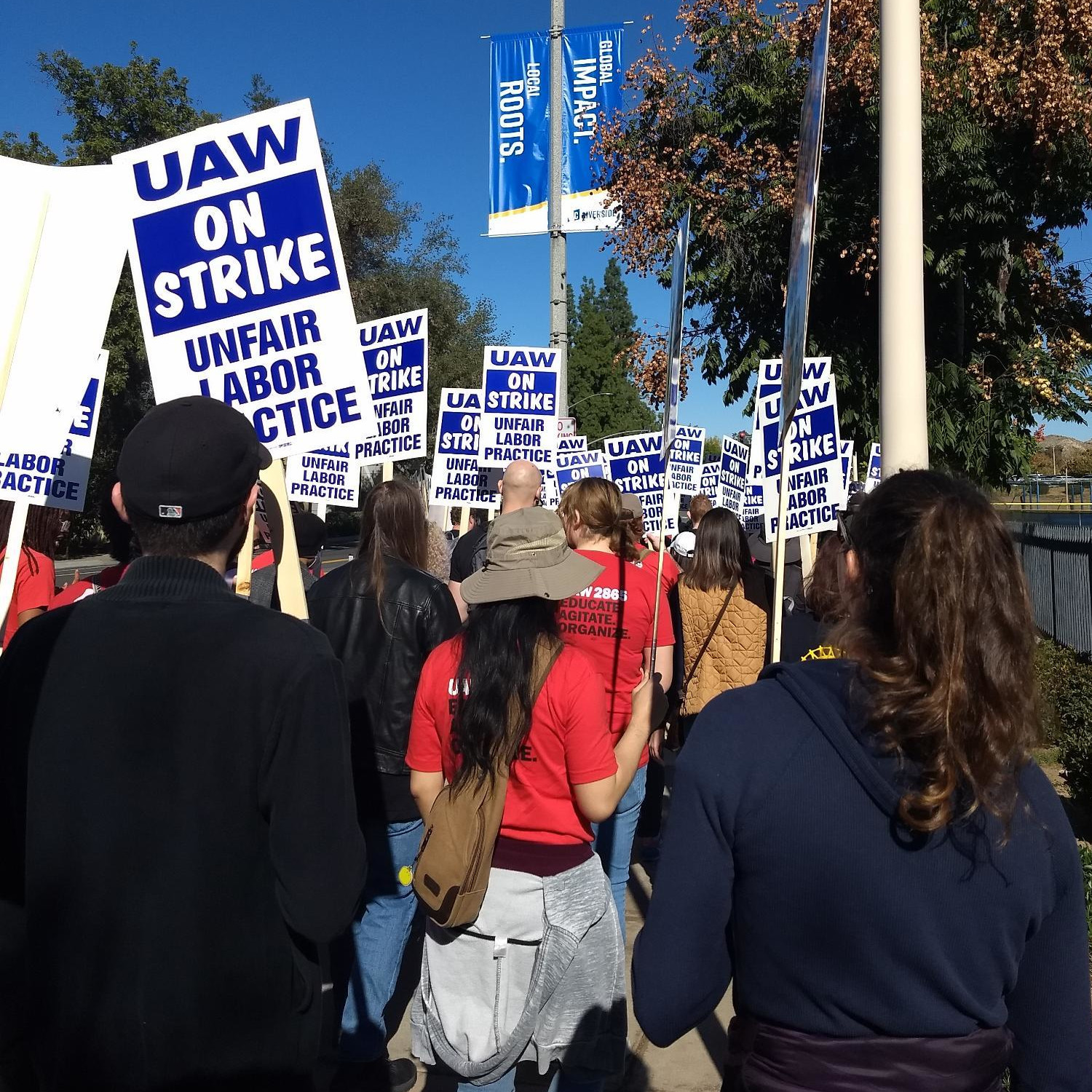
December 12, 2022
The faculty of the Ethnic Studies Department at the University of California, Riverside supports the academic student workers who remain on strike during this historic and unprecedented statewide action. These academic workers, scholars and teachers in their own right, are asking the university to make good on their requests for a living wage to support their communities and families in the state of California, a state with the historically highest costs of living. They deserve not only a living wage, but equitable coverage of other academic and living expenses. They are also entitled to workplace protections in which exercising their right to protest is not met with threats of police intimidation and violence.
We affirm the right of academic student workers to engage in strike activity, which may include picketing, cancellation of sections, and stopping grading. The ETST Senate faculty overwhelmingly expressed their support to stand with the striking workers and heed their call to withhold grade submissions until the strike ends. Additionally, we assert that it is the university’s responsibility to develop contingency plans to ensure that student degree completion, eligibility, financial aid, and good standing are not impeded by struck labor, including grade submission.
We encourage faculty in other departments at UCR and UC-wide to take a similar stand. Systemic changes within the UC system are long overdue, and we support an imminent future in which this is possible.
Edward Chang
Gerald Clarke
Adrián Félix
Emily Hue
Wesley Y. Leonard
Keith Miyake
Jennifer Nájera
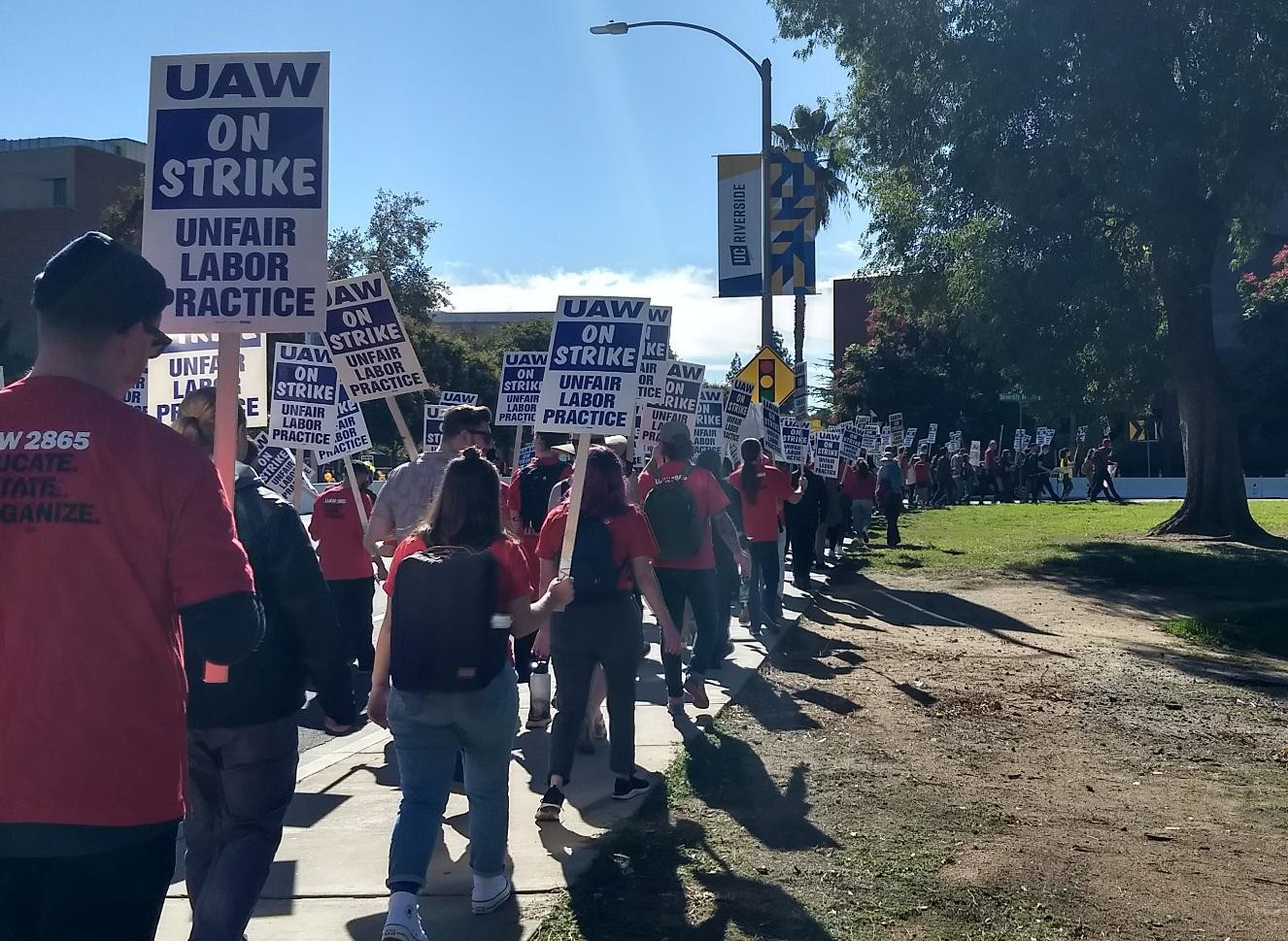
As faculty in the Department of Ethnic Studies we stand in solidarity with UAW graduate student workers and postdoctoral fellows who are on strike.
We recognize that the university could not fulfill its mission without the labor of its graduate student workers who perform key research, teach classes, grade papers, and provide invaluable support in teaching and mentorship for undergraduate students across the University of California.
Especially given the rapidly rising costs of living around UC communities, graduate student workers deserve a contract that secures a living wage, basic needs, as well as increased job security. We value their demands for a fair contract that is attuned to international workers’ rights and student parents’ rights as well as for greater disability and climate justice.
Ethnic Studies scholars and practitioners are particularly attuned to the critical role that organized labor has played for communities of color to access rights that might otherwise not have been available to them because of their race, gender, language, and/or immigration status. Labor rights have often been the precursor to other kinds of legal rights.
We affirm the right of student workers to engage in lawful strike activity, which may include picketing, cancellation of sections, and stopping grading. We will not engage in retaliation against graduate students based on their participation or non-participation in strike activities in all matters under our direct control, and we oppose unlawful retaliation measures against either striking students or faculty respecting the picket line.
We will respond to undergraduate concerns about the disruption of their education with compassion while affirming the right of graduate students to strike for adequate benefits and compensation. We urge the university to take all measures to protect international students, and we will take all measures in our power to protect our international student workers.
We urge the university to bargain in good faith with the union so that a just and adequate solution may be reached.
We hope that this strike starkly demonstrates to the university administration just how integral graduate student labor is to the UC system.
Edward Chang
Gerald Clarke
Adrián Félix
Alfonso Gonzales Toribio
Emily Hue
Wesley Y. Leonard
Alfredo Mirandé
Keith Miyake
Jennifer Nájera
Andrea Smith
Jasmin A. Young

Michelle Rawlings & Darielle Martin – Wilmer and Velma Johnson Ethnic Studies Undergraduate Award: Competitive scholarship presented annually to a student who best demonstrates their writing aptitude and familiarity with Ethnic Studies concepts
Madison Garcia – Katherine Saubel Award: Presented annually to the graduating senior who best promotes the preservation of cultural awareness
Bibiana Canales – Barnett Grier Award: Presented annually to the graduating senior who best promotes ethnic awareness
Christopher Valdez – Sister Rosa Marta Zarate Award: Presented annually to the graduating senior Ethnic Studies major in recognition of service to the community
Michelle Rawlings & Katianna Warren – Dosan Ahn Chang-Ho Award: Presented annually to the Junior Ethnic Studies major with the highest overall GPA
Manuel Zarate & Bibiana Canales – Sumi Harada Award: Presented annually to the graduating Ethnic Studies joint major with the highest overall GPA
Violetta Price & Alana Pitman -Maurice Jackson Award: Presented annually to the graduating Ethnic Studies major with the highest overall GPA
Naomi Waters – Ernesto Galarza Award: Presented annually to a junior Ethnic Studies major in recognition of service to the community
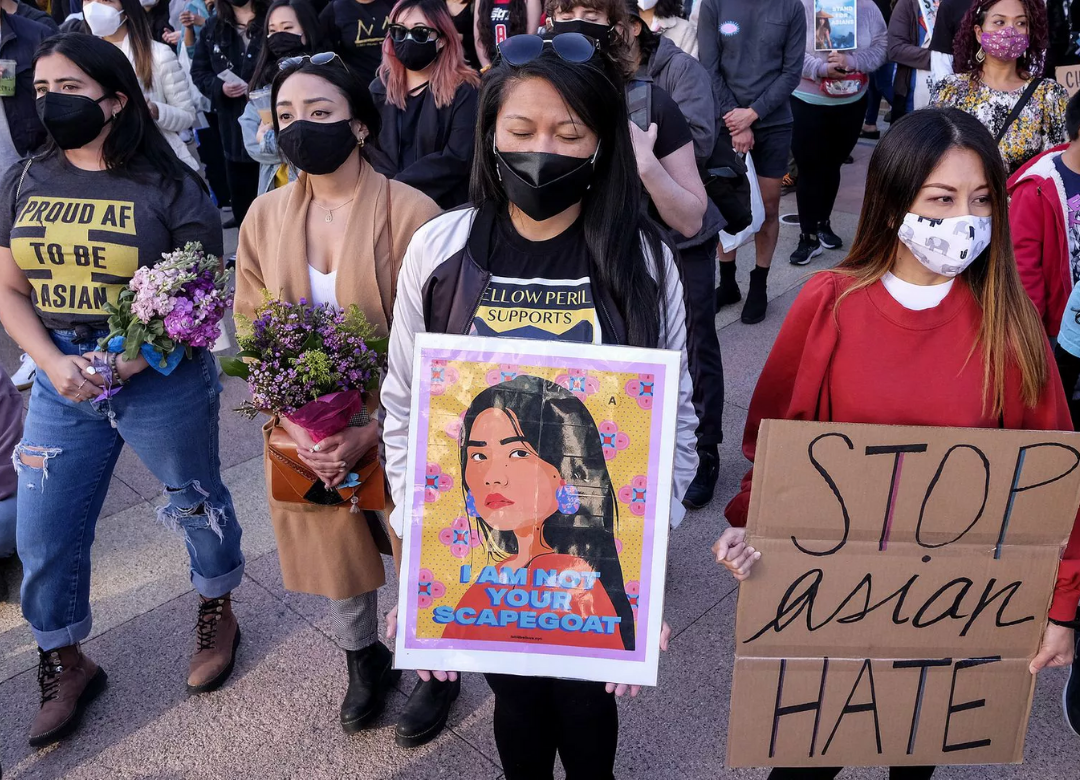
Community Resources on Anti-Asian Violence, Curated by the UCRFTP Cops Off Campus Collective
This curated list of non-carceral statements, events, reporting, and resources speak to the longstanding and ongoing racialized misogyny, xenophobia, and fear of sex workers that have contributed to the countless acts of individual and state violence targeting Asian femmes, sex workers, elders, and others, and which contextualize the murders of spa workers in Atlanta on March 16, 2021. As we continue to have these important conversations, we hope the following resources provide guidance, analysis, support, and paths toward community-oriented action and collective healing.
Public Events
Statements/Sign-ons
Reportage and Perspectives
Additional Resources/Reading
Photo above: Demonstrators ake part in a rally to raise awareness of anti-Asian violence n Los Angeles. Photo : Ringo Chiu/AFP via Getty Images
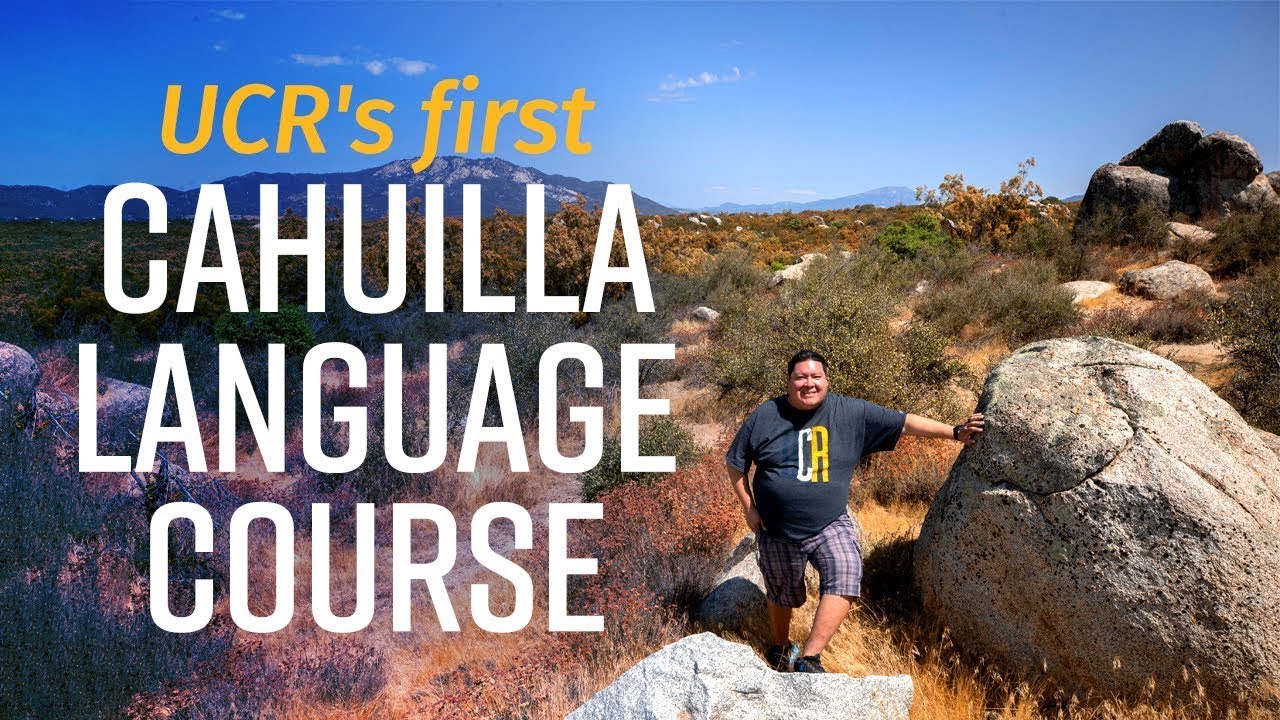
Native American Studies Ph.D. student, William Madrigal, is leading an historic initiative to offer Cahuilla language as an accredited language series, making UC Riverside the first UC campus to do so. Article from UCR News by Sandra Baltazar Martinez below:
The University of California, Riverside, is the first UC campus to offer Cahuilla language as an accredited language series.
Cahuilla, the language of Southern California Cahuilla Indian Nations, is offered by the Department of Comparative Literature & Languages at UCR. This four-class series includes three lower-division courses and one-upper division class, which satisfy undergraduate foreign language requirements for most of the College of Humanities and Social Sciences majors.
Doctoral student William Madrigal Jr., a member of the Cahuilla Band of Indians, has been teaching three of the four classes since their inception in winter 2018. The courses are open to all UC students and Cahuilla tribal community members, thanks to concurrent enrollment.
“The interesting thing here is that Cahuilla is not a foreign language because it’s very much local and indigenous to Riverside County,” Madrigal Jr. said. “Students are learning more than just the mechanics of the language. They are learning about a rich and vibrant culture. They are introduced to the Cahuilla culture, philosophy, and worldview.”
Madrigal Jr., 38, who is working toward a doctorate in Native American Studies, is a member of one of the 10 existing Cahuilla sovereign nations. Growing up on the reservation, located in Anza, about 75 miles south of Riverside, he felt an obligation to attend college and help revive a language that had been suppressed — and almost eradicated — by federal government mandates.
Over 150 years ago, the United States federal government dispersed Native Americans into reservations, sending young children to boarding schools where they were forced into assimilation and only allowed to speak English. The practice of stripping Native Americans from their California lands started around 1850, and as early as 1830 in other parts of the country.
The Cahuilla currently reside on 10 different reservations, their total population ranging from 3,000-5,000 people. Before being separated, their population was more than double that amount, Madrigal Jr. said.
Cahuilla elders and leaders held onto their native language and continued to share oral histories, traditions, and culture with the rest of the families and community throughout this trying period.
“Knowing that our origins were special made me proud growing up,” Madrigal Jr. said. “I’m proud of who I am and where I come from.”
Raymond Huaute, a doctoral linguistics student from UC San Diego, teaches UCR’s upper-division Cahuilla literature course. Huaute is Cahuilla and Chumash California Indian.
Creating and funding these courses at UCR became a multiyear process supported by UCR Chancellor Kim A. Wilcox, as well as the university’s administration, faculty, graduate students, and the Office of Diversity, Equity & Inclusion, Madrigal Jr. said.
The campus itself sits on land where Cahuilla, Tongva, Luiseño, and Serrano people once lived and thrived next to the Santa Ana River.
Students in Madrigal Jr.’s three conversational language classes study stories that highlights the Cahuilla way of life, he said.
Madrigal Jr. said the Cahuilla language revitalization movement started roughly 50 years ago, when less than a dozen elders spoke the language daily. Now, because of their efforts, there are hundreds of Cahuilla learners who are working with linguistic and anthropological materials recorded long ago to bring Cahuilla back.
“We’re trying to save the essence of our identity inextricably linked to the Cahuilla culture,” Madrigal Jr. said.
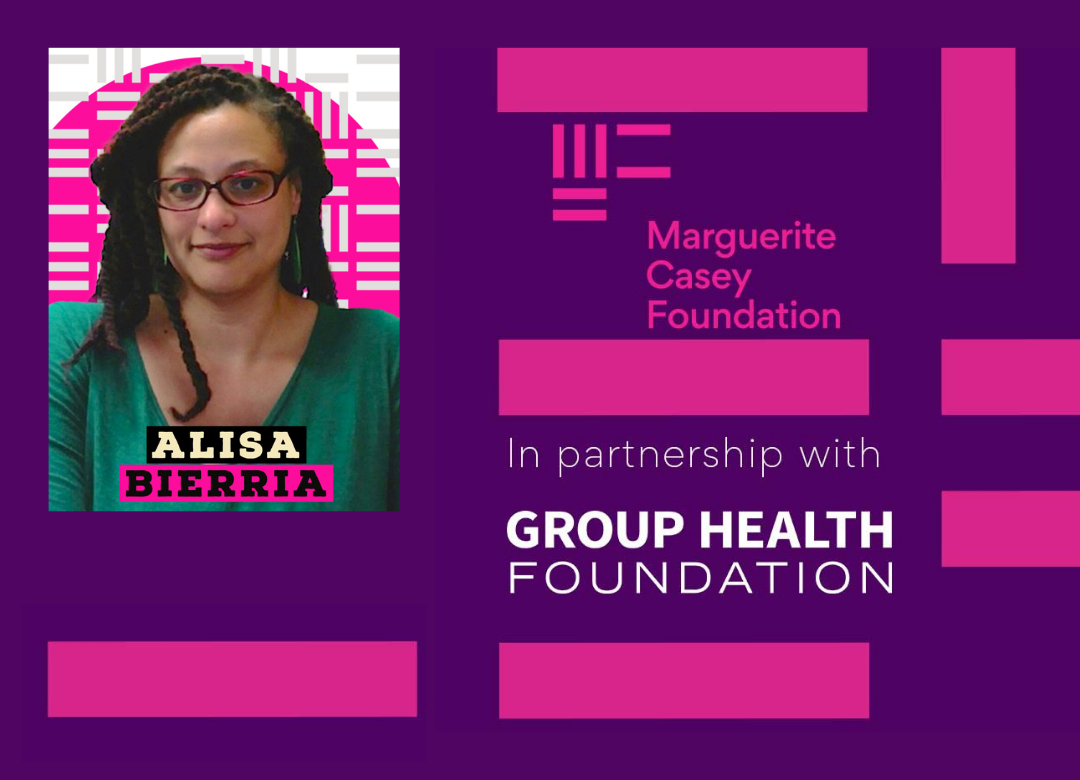
The Marguerite Casey Foundation launched a new $3 million initiative, the Freedom Scholars, to support social and economic justice scholarship. Ethnic Studies faculty member, Prof. Alisa Bierria, has been named as one of twelve members of the initiative’s inaugural class. Announcement excerpt below:
The nation’s boldest scholars stand at the forefront of movements for economic and social justice – they are creating the catalytic ideas for transformative change. Marguerite Casey Foundation and Group Health Foundation are placing power in the hands of these changemakers through new Freedom Scholars Awards, $250,000 grants that give leaders greater freedom to build a truly representative economy that works for working families and people.
The $3 million Freedom Scholars program is a commitment to scholarship that is rooted in and supports movements led by Black and Indigenous people, migrants, queer and poor people, and People of Color. The awards support scholars who are shifting the balance of power to families and communities that have been historically excluded from the resources and benefits of society. With this award, Marguerite Casey Foundation and Group Health Foundation are recognizing the role that scholars play in cultivating the intellectual infrastructure necessary to nurture movements toward freedom.
Today’s Freedom Scholars work at the forefront of abolitionist, Black, feminist, queer, radical, and anti-colonialist studies and critical fields of research that are often underfunded or ignored. Support for their research, organizing, and academic work is pivotal in this moment when there is a groundswell of support to hold our political and economic leaders accountable.